New Publication
The Impact of AI on Eye Gaze Patterns in Chest X-Ray Interpretation An Eye Tracking Study of Novice and Expert Radiologists
Investigative Radiology
Belde Dana, Kapaj Armand, Fabrikant Sara Irina, Reichenbacher Tumasch, Frauenfelder Thomas, Nguyen-Kim Thi Dan Linh, André Euler, Kettner Mattias, Thali Michael, Kubik-Huch Rahel A., Niemann Tilo
Abstract
Purpose: To investigate how artificial intelligence–assisted chest radiograph interpretation influences eye gaze patterns in novice and expert radiologists.
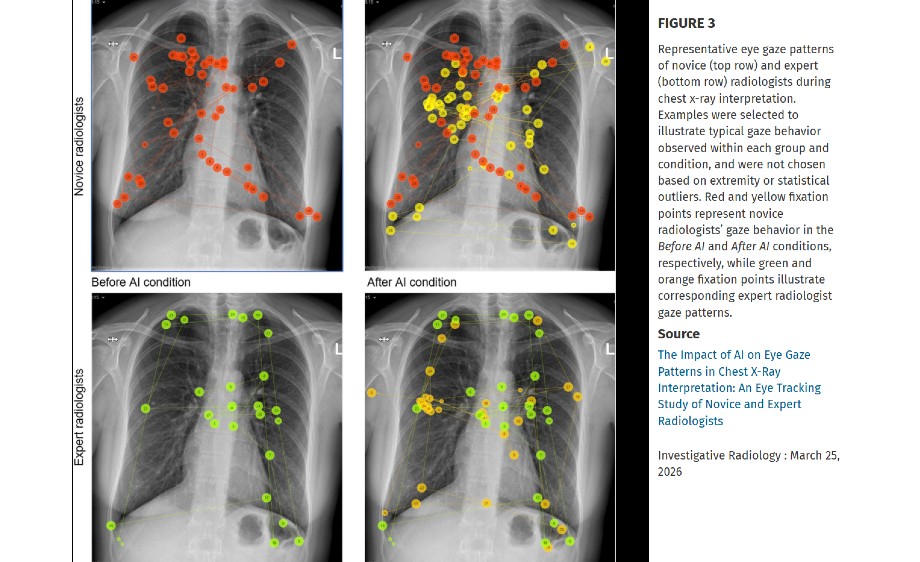
Materials and Methods: This prospective eye tracking study included 6 novice radiology residents and 6 expert cardiothoracic radiologists. Fifty anonymized posteroanterior chest radiographs were interpreted under 3 conditions: Before AI, With AI, and After AI. An AI-Rad Companion Chest x-ray algorithm generated visual annotations and confidence scores. Eye movements were recorded at 250 Hz. Fixation sequences were analyzed using a 7 × 7 grid and quantified with normalized Levenshtein distance as a measure of systematic viewing behavior. Linear mixed-effects models assessed the effects of condition, expertise, and their interaction.
Results: Viewing patterns were significantly less systematic in the With AI and After AI conditions compared with Before AI. A significant interaction between condition and expertise was observed. Novice radiologists demonstrated markedly increased gaze dissimilarity during AI-assisted interpretation and remained less systematic after AI exposure. Expert radiologists showed no significant differences in gaze behavior across conditions, maintaining stable and systematic viewing patterns.
Conclusions: AI assistance disrupted systematic visual search behavior in novice radiologists but not in experts. These findings indicate that AI exposure may interfere with the stability of foundational perceptual search strategies in trainees, whereas experts integrate AI without altering established viewing patterns. Implications for radiology training warrant careful consideration.