New Publication
Uncertainty visualization and attitudes toward climate change affect trust in climate change maps
Cartography and Geographic Information Science
Sergio Bazzurri, Sara I. Fabrikant
Abstract
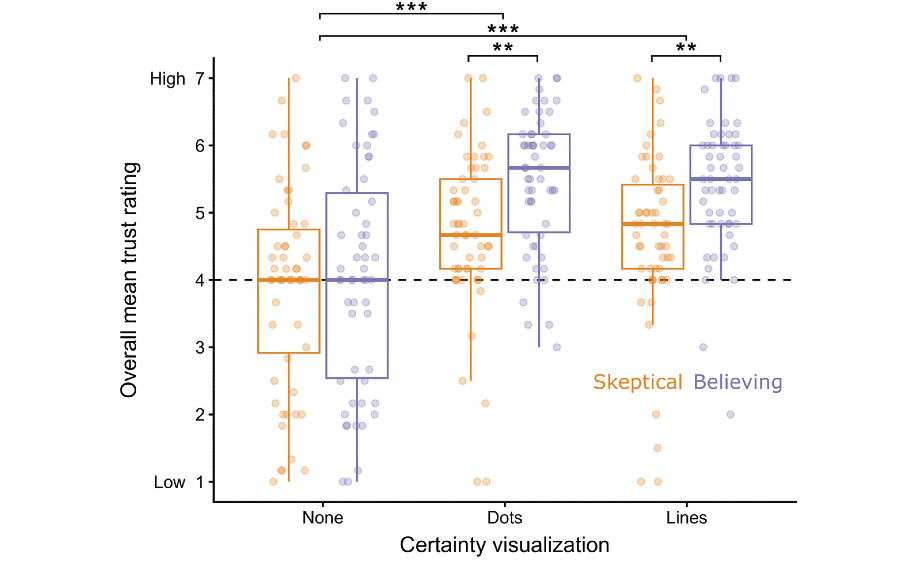
Policymakers often rely on map-based decision-making, informed by visualized climate data, to mitigate the impacts of climate change. Clear visual communication of uncertain climate futures is especially critical in the polarized and emotionally charged context of climate change. We conducted an empirical map-based decision-making study with 109 participants recruited online via Prolific. Two groups (control vs. emotional narrative), each equally composed of climate change skeptics and believers, were shown 18 climate change maps, depicting either data uncertainty as dots or line patterns or not at all. Participants rated the certainty and the severity of the predicted change at selected locations and rated their trust in the visualized data. The emotion manipulation had no significant effect. Importantly, we did find significantly higher trust ratings for maps that visualize uncertainty information than for those that do not. Map trust is greater among climate change believers, who assessed the depicted changes as more severe than skeptics. Our findings emphasize the importance of visualizing uncertainty and developing appropriate visualization guidelines to communicate uncertainty in climate change forecast maps to audiences with varying climate attitudes. Future research should further explore how different modes of emotion-inducing narratives interact with climate change skepticism in visual climate communication.