New publication
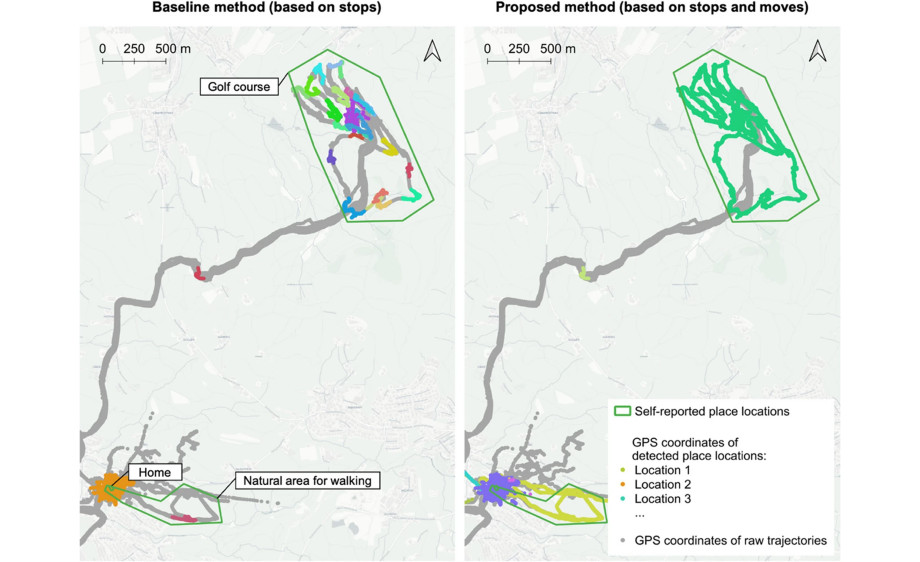
Conventional methods of detecting place locations from GPS data define places solely from where people stop, treating movement as merely travel between places. But what about places where movement is part of the experience? Think of a park, the area where you regularly walk your dog, a zoo, a golf course, or a university campus. These aren’t just collections of stopping points—they’re places we experience by moving through them.
In a recent paper led by our PhD student Changyu Han, we propose a different way of detecting places from GPS trajectories: one that integrates both stops and moves to capture the full spatial footprint of everyday places. Evaluated with manually delineated place footprints from 145 participants, our approach detected more complete place locations than state-of-the-art stops-only methods, with the biggest gains in low-density environments.
We hope this work provides a stronger foundation for trajectory-based research on human behavior, human–environment interactions, and applications ranging from environmental exposure assessment to landscape and urban planning.
Sometimes, improving our models doesn’t require more data—it requires rethinking the concepts behind them.