Workshop Review: The Global Pesticide Complex – New Research Directions in a Multipolar World
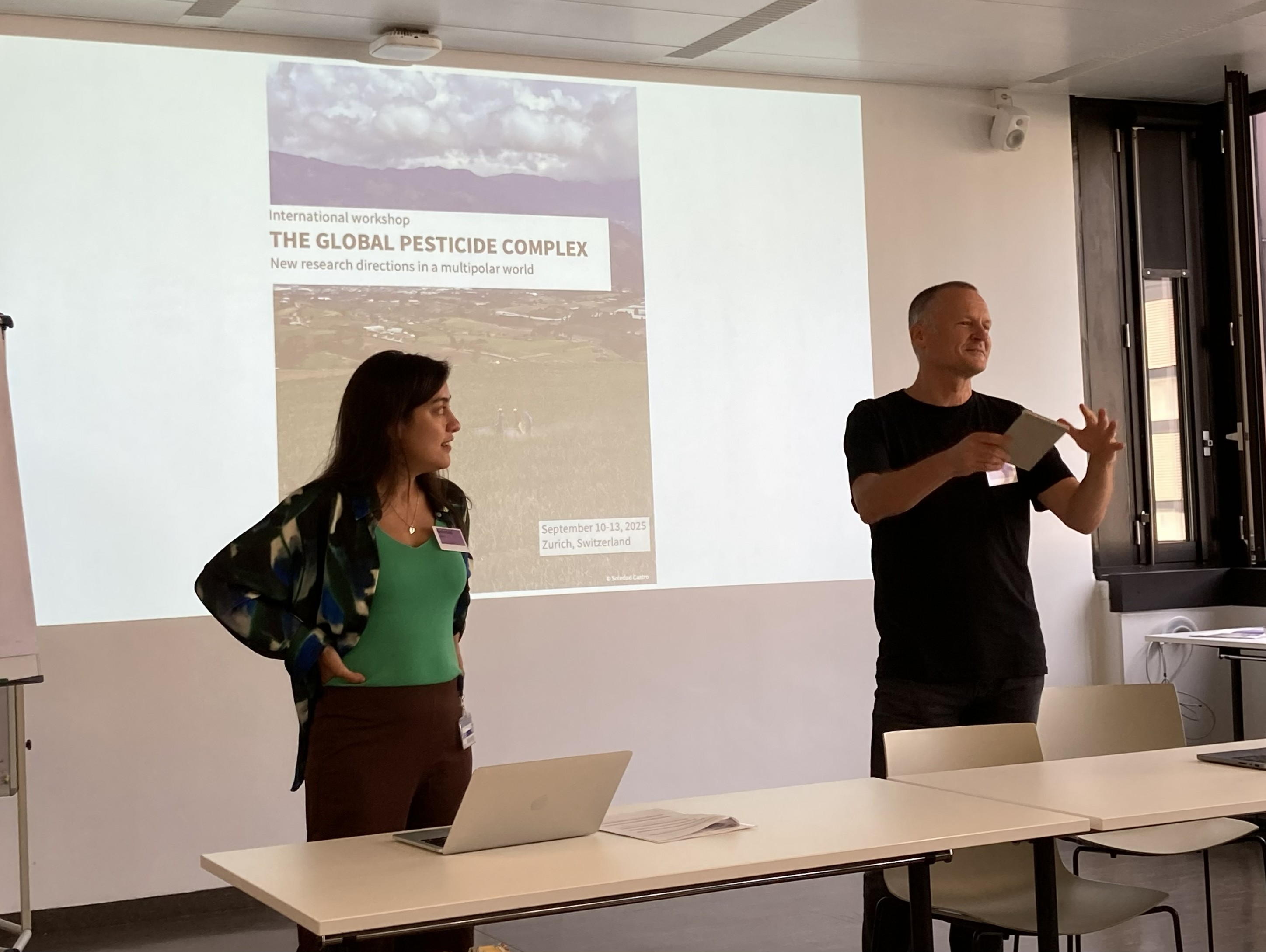
From 10–13 September, a group of 20 scholars and civil society representatives from across the globe gathered at the University of Zurich for a three-day workshop exploring how pesticides are produced, marketed, regulated, and contested in an increasingly multipolar world. Convened by Soledad Castro, Christian Berndt and Marion Werner – with support from the Swiss National Science Foundation (SNSF) and the University of Zurich – the event brought together a wide range of perspectives to better understand today’s rapidly evolving pesticide landscape.
The workshop opened with early findings from the SNSF project “Making Herbicide Markets: Interactions between production restructuring, agriculture and environment in Latin America and Asia”, which investigates the restructuring of the global agrochemical industry. The project analyzes pesticides as specific drivers of economic and ecological change by interrogating the transformative role of new emerging-market generic production networks in relation to farming practices and environmental effects in Latin America. Christian Berndt shared some initial reflections across three key research themes which opened a discussion: Dynamics on Latin America pesticide trade; Following agrochemicals upstream: Assembling pesticides; and Reconstructing the last mile: Pesticide distribution and use.
Two main panels sparked a further collective discussion. The first panel, “The Global South and the Global Pesticide Complex” included several presentations centered on the lived realities of pesticide use and governance in the Global South. Anthropological research from Cambodia illustrated how pesticides permeate everyday life – shaping health practices, labor relations, environmental conditions, and local politics. From Argentina, researchers examined how the global pesticide complex interacts with domestic agrochemical sectors, focusing on the role of chemical mixtures in altering agricultural frontiers and interfacing with alternative agricultural practices. The session concluded with a glimpse at China’s rapidly expanding agrochemical industry through different historical phases and the global reach of Chinese firms whose internationalization strategies are increasingly remaking pesticide markets worldwide.
A second panel “Regulation: Bans, Scalar Tensions, and Geopolitical Shifts” unpacked the persistent challenges of governing pesticides across scales. Participants discussed how banning a single compound can unintentionally open the door to new – and not necessarily safer – alternatives. The discussion further examined evolving dynamics in key global arenas, such as the FAO and the Rotterdam Convention, showing how shifting geopolitical priorities are reshaping regulatory agendas and outcomes. Beyond changes in governance structures, the panel considered emerging questions around the ownership of risk knowledge, the management of pesticide waste, and the role of the agrochemical industry in shaping regulatory science – all of which point to the growing complexity of pesticide regulation in an interconnected world. This challenge is further compounded by the ubiquity of pesticides – a feature that, as one participant observed, simultaneously necessitates regulation and hinders its effectiveness.
Drawing on these insights and through collective discussion, participants identified several priority research areas. These emerging directions focus on strengthening links between advocacy and academic research; understanding the relationship between state regulation and global industry; examining how new technologies are reshaping agrarian systems; and analyzing the growing importance of chemical mixtures within “more-than-pesticides” approaches.
A standout feature of the workshop was a dedicated dialogue between researchers, NGOs and civil society organizations, including Critical Scientists, Public Eye, CCFD Terre Solidaire, and Corporate Europe Observatory. The organizations presented their work on pesticides, including research on highly hazardous pesticide trade and campaigns to ban their exports. Participants shared strategies, identified overlapping challenges, and emphasized the need to move beyond isolated projects toward collective efforts capable of addressing the scale and complexity of pesticide-related problems.
The workshop concluded with two sessions on methodological hurdles common in pesticide research, offering a look at both global and country-level challenges. Participants were introduced to the Global Pesticide Use and Trade Database (GloPUT), followed by a deep dive into a pesticide data-analysis project in Costa Rica led by Soledad Castro in collaboration with Ryan Galt and Santiago Alvarez. The closing discussion focused on issues with inconsistent and limited data in China. Participants discussed strategies for dealing with poor or incomplete data – often a consequence of industry opacity – and shared approaches for studying agrochemical companies, from long-established multinational corporations to rapidly growing generic producers.
Overall, the workshop highlighted the need to understand pesticides not just as chemical substances, but as dynamic, multifaceted objects shaped by markets, politics, technologies, and everyday social struggles. As new producers and geopolitical powers reshape the global pesticide complex, interdisciplinary research and stronger links between academia and civil society are becoming increasingly urgent. A key outcome of the workshop is the commitment to develop a coordinated research roadmap that synthesizes shared insights and charts a collective vision for future work.
Photos: Workers in the field by Soledad Castro and presenters by Hanna Tscharland