Mountain disasters like Nepal's Rasuwa catastrophe demand a new way of assessing risk
An avalanche and flood that killed thousands in Nepal's Rasuwa district on 26 August shows that current approaches to mountain risk assessment have failed, argue the authors of a commentary in Nature. They propose replacing single-method, history-based analysis with a complementary set of approaches that capture cascading hazards – from storyline approaches to risk-network mapping.
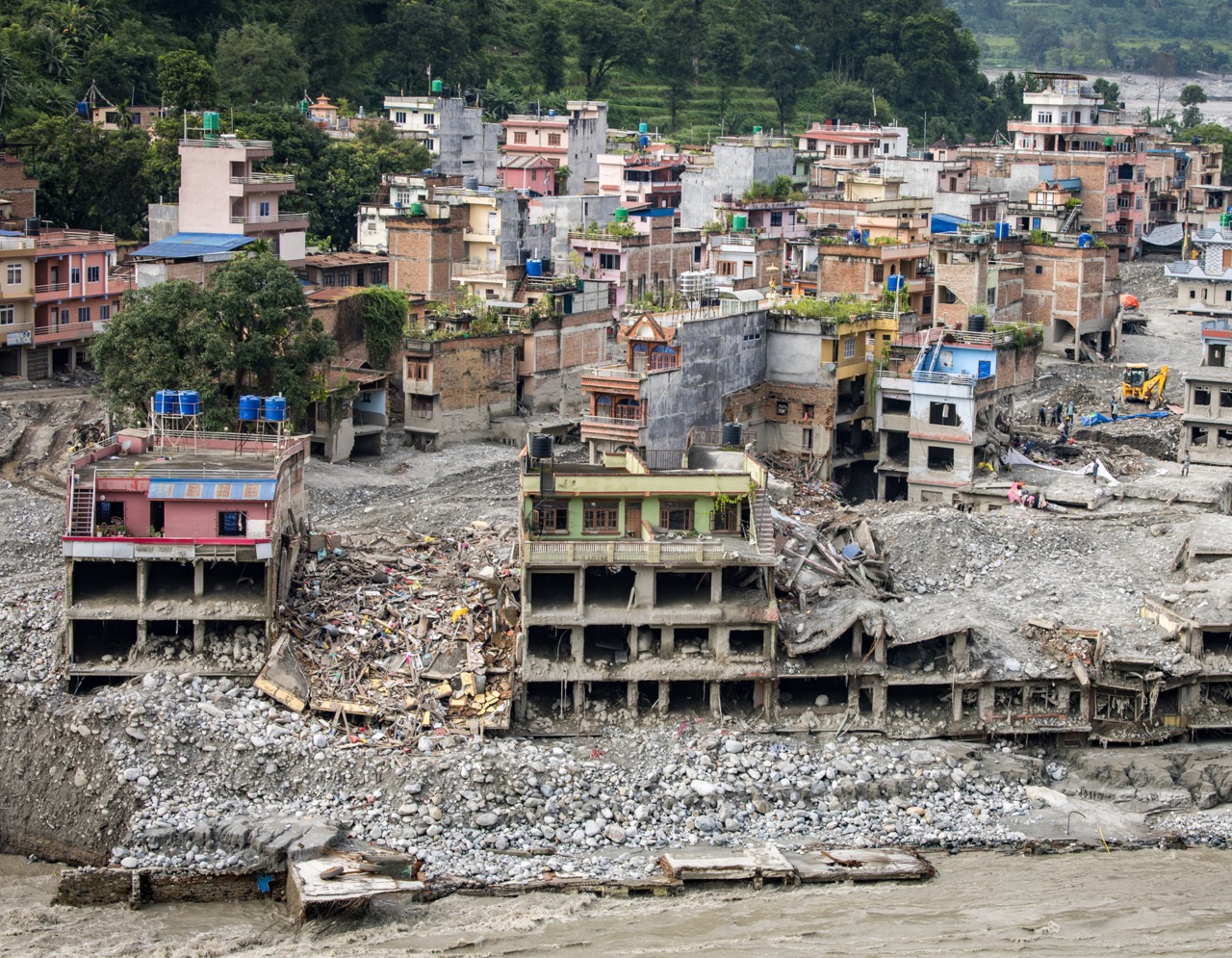

The Rasuwa disaster is not a freak event. In recent years, the world has witnessed several comparable rock and ice collapses followed by devastating floods. These events result from interacting, cascading processes: slope and glacier collapses, bank failures, lake outbursts and the further entrainment of water, debris and sediment as floods race downstream. Yet the likelihood of such events is typically gauged from the historical record. But events of today's magnitude are rare or missing from those archives.
The need to re-evaluate risk analysis
Scientists and decision makers must rethink how they analyse hazards and risks in mountainous regions. Rather than a single method, Christian Huggel, Simon K. Allen, Jakob Steiner and their co-authors propose a complementary set of approaches that can be combined as needed depending on the context.
Define and agree on purpose and scope: A risk analysis can inform land-use planning, guide funding, identify protection gaps, estimate economic losses or set priorities – from a single hydropower plant to large, populated regions. Governments and local communities must jointly decide what level of risk is tolerable and how to protect the most vulnerable.
Combine multiple methods: Storyline approaches can explore far-reaching cascading effects beyond current populations and structures, while risk-network analysis exposes gaps such as the consequences for disadvantaged populations.
From probability to plausibility
Risk management should shift from asking how likely a hazard is to asking what sequences of events are physically plausible – and what consequences society is willing to accept. Rapid, climate-driven change in the Himalayan environment, as in mountain regions worldwide, is colliding with populations and infrastructure that have expanded massively over recent decades. Relocation, typically seen as a last resort, may become necessary to save lives, but smart approaches can reduce its social, political and economic costs.
LiteratureChristian Huggel, Simon K. Allen, Emily Mark, Dan H. Shugar, Jakob Steiner & Kavita Upadhyay: Nepal’s disaster is an urgent wake-up call. Nature 658, 868-871 (2026) |
Title image: Jitendra R Bajracharya, ICIMOD