European State of the Climate 2025: accelerating extremes and continued glacier loss
The European State of the Climate 2025 (ESOTC 2025) report combines observations from across the climate system, including atmosphere, oceans, and the cryosphere, with contributions from the World Glacier Monitoring Service (WGMS) at the University of Zurich, as in previous years.
The European State of the Climate 2025 (ESOTC 2025) report provides a comprehensive overview of climate conditions across Europe during the past year. The report, jointly published by the Copernicus Climate Change Service (C3S) and the World Meteorological Organization (WMO), shows that Europe continues to experience rapid warming and increasingly frequent climate extremes. The report combines observations from across the climate system, including atmosphere, oceans, and the cryosphere, with contributions from the World Glacier Monitoring Service (WGMS) at the University of Zurich, as in previous years.
The report once again highlights the rapid and persistent changes affecting Europe’s climate system. It underscores the critical importance of long-term, coordinated observation networks such as those of WGMS, Copernicus, and WMO to track these changes and support informed decision-making.
Key findings for 2025
• Europe remains the fastest-warming continent, with widespread above-average temperatures
• Around 95% of Europe experienced warmer-than-average conditions
• Persistent heatwaves, droughts, and record wildfire activity affected large regions
• Record-high sea surface temperatures and marine heatwaves were observed
• Renewable energy reached a new high share of Europe’s electricity generation
Continued glacier mass loss
The World Glacier Monitoring Service (WGMS) provides long-term glacier observations that underpin the cryosphere assessment in the ESOTC.
In 2025:
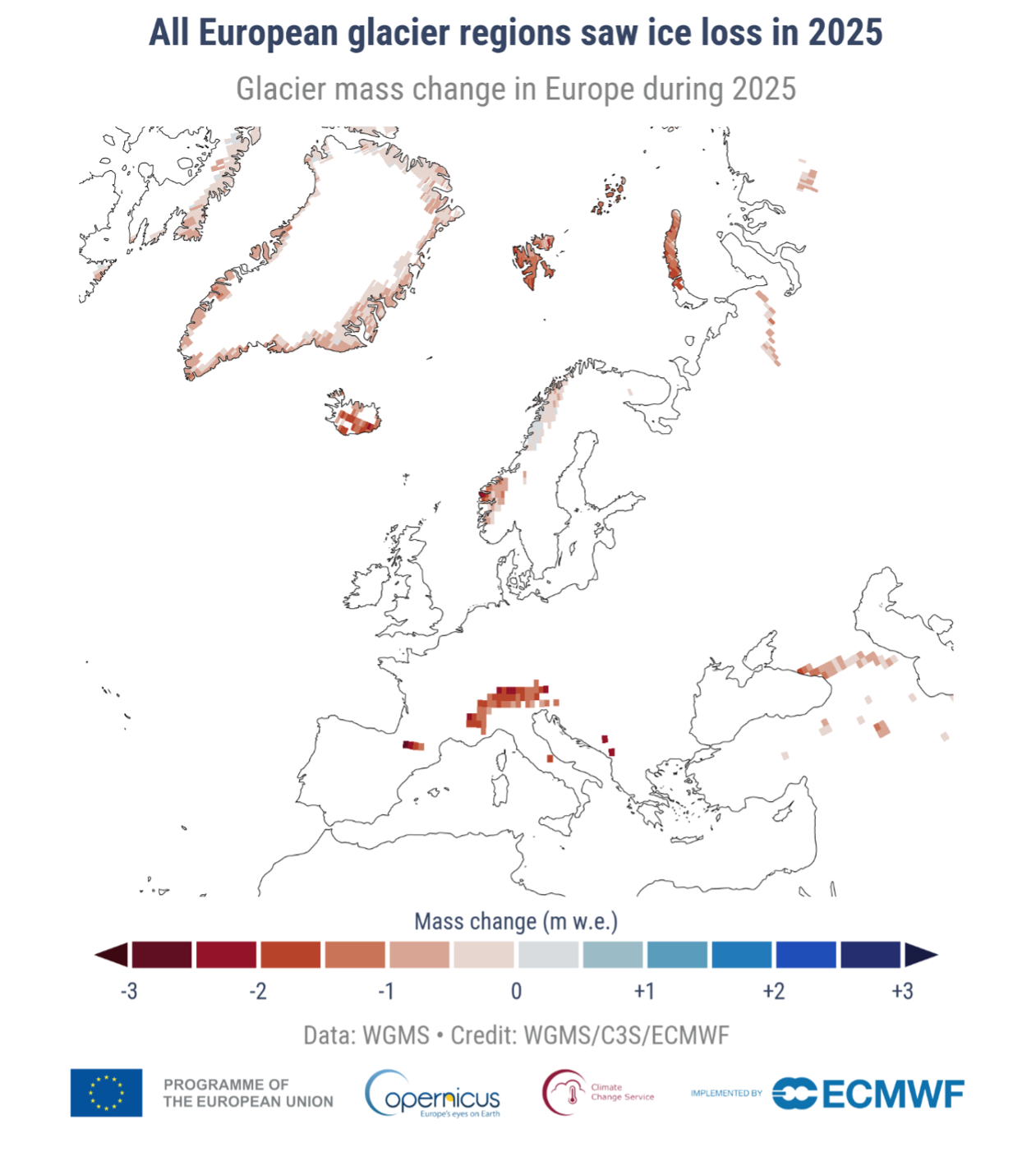
• All European glacier regions experienced net mass loss
• The most pronounced losses occurred in Iceland (1.55 m w.e.), Central Europe (1.38 m w.e.), and Svalbard (1.21 m w.e.).
• Iceland recorded its second-largest glacier mass loss on record
• Europe’s glaciers continue to contribute significantly to global sea-level rise, while also increasing hazards such as floods and landslides.
Data
WGMS (2026): Annual mass-change estimates for the world’s glaciers (version 2026-02-10). https://doi.org/10.5904/wgms-amce-2026-02-10
Links
https://climate.copernicus.eu/esotc/2025
https://climate.copernicus.eu/esotc/2025/graphics-gallery/glaciers
https://wgms.ch/ncc_glaciers_in_2025/
https://climate.copernicus.eu/esotc/2025/glaciers
https://cds.climate.copernicus.eu/datasets/derived-gridded-glacier-mass-change
https://cds.climate.copernicus.eu/datasets/insitu-glaciers-extent