Can GNSS-Based VOD Help Monitor Plant-Water Relations and Growth of Maize?

In recent years, reports of crop losses caused by drought and other extreme weather events have become more common across Europe. Switzerland is no exception. Following an unusually dry spring, this year could become one of the country's most severe drought years in recent decades. The Swiss Farmers' Union has warned that rainfall has been well below average since May, while further heatwaves are forecast in the coming weeks.
Reliable information on crop water status is therefore becoming increasingly important for farmers. But how can we improve the monitoring of drought stress in crops, and how does it affect plant growth? We are addressing these questions in a new season-long field experiment as part of the NextGenCarbon project. The study investigates whether GNSS-based vegetation optical depth (VOD) can improve the monitoring of plant water status and biomass development in maize.
Two GNSS approaches
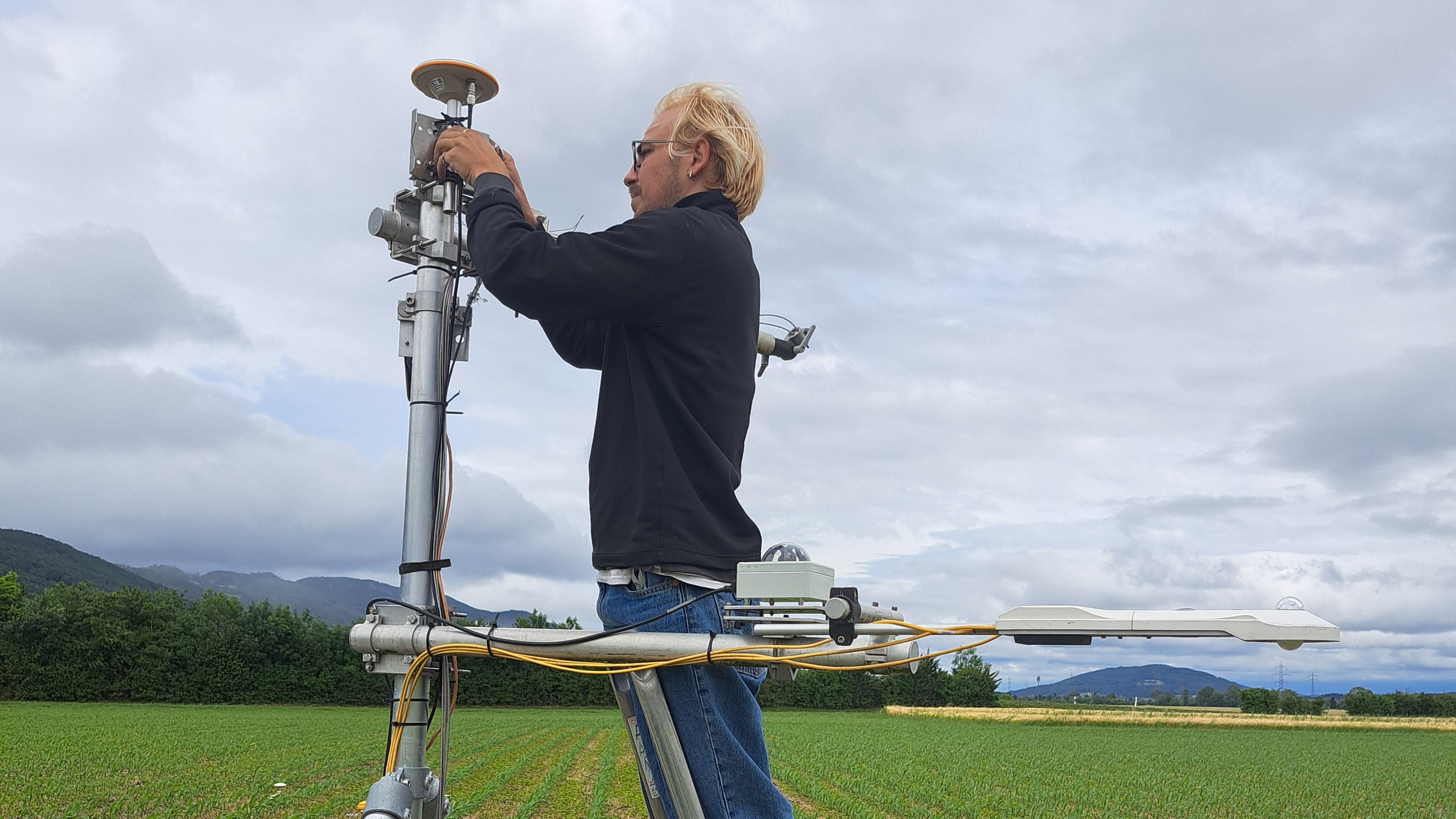
For the experiment we are using an established method called GNSS Transmissometry (GNSS-T), which measures how much satellite signals weaken as they pass through the crop canopy. The denser and wetter the vegetation, the more the signals are attenuated. This information can be used to estimate vegetation optical depth (VOD), an indicator of plant biomass and water content.
In addition, we are testing a second approach, GNSS Reflectometry (GNSS-R). Instead of measuring signals that travel through the plants, this method analyzes signals reflected from the ground and vegetation. By comparing both approaches side by side over an entire growing season, we want to see how they complement each other and whether GNSS-R can provide additional information on soil moisture and the water status of crops.
The test site
Maize was chosen as the experimental crop because of its rapid growth and dense canopy. These properties provide a clearer signal and will help us to evaluate how well both methods work.
To validate these measurements, the GNSS setup has been integrated into an existing field experiment led by the group "Grassland Sciences" at,ETH Zurich. We can use this data to compare the GNSS-derived information with detailed observations of plant physiology and micrometeorological conditions.